Planning my 2nd SaaS
I’m building a second SaaS product - this time, based on a growth iteration model I’ve been refining over the past few years. I’ve taught it to over 300 founders and operators. It’s helped drive results in teams like Freska. And now I’m trying to compress it into software.
But...
As a VC, I’ve watched talented teams build promising “growth OS” tools that end up in the same graveyard. They all had structure and they all had logic. Some even had traction in the beginning. I got excited as a domain expert. But they didn’t stick.
Here’s what I think they got wrong and what I’m trying to do differently.
The illusion of structure
Most growth tools give you tasks, which can be a list, a funnel, or a set of dashboards.
But they rarely give you strategic leverage.
They help you run motions. They don’t help you learn.
They track activity. They don’t evolve your GTM thinking.
And they rely on users who are already disciplined and strategic. That’s the trap.
If the system adds mental overhead, it dies.
No matter how good the framework is.
The model I’m building around
I’ve taught this iteration model to hundreds of people, like growth leads, founders, and early teams. When it works, it creates repeatable learning velocity and compounding insight. But there are conditions:
- It only works if people actually run structured loops: What are we testing? What’s the hypothesis? What happened? What does it change?
- It only clicks if they do it consistently for ~2 months. After that, they stop questioning it because the results speak for themselves.
- It only scales if learning and insight become outputs, not just activity logs.
So that’s what I’m building toward.
Two hard problems I think are worth solving
1. Generating real learning
Most founders or growth operators run tests. Very few learn from them. It's very hard to make people just sit and think about what I really learned from this. People are not stupid, but as they often feel "expected" to be in constant motion and "busy" to be "relevant" - they simply don't stop and think.
AI might change that.
If a system can help extract insights from each loop (summarize results, detect patterns, and suggest what to change), it can dramatically shorten the path to clarity.
2. Driving org-level growth behavior
This is harder.
Founders and growth operators don’t just need tools to do growth - they need to lead growth. That means nudging product, sales, and ops into the loop.
Again, AI might help. Not by managing the team, but by flagging when collaboration is missing, when a motion needs cross-functional input, or when decisions are being made in isolation.
What I’m actually building (V1)
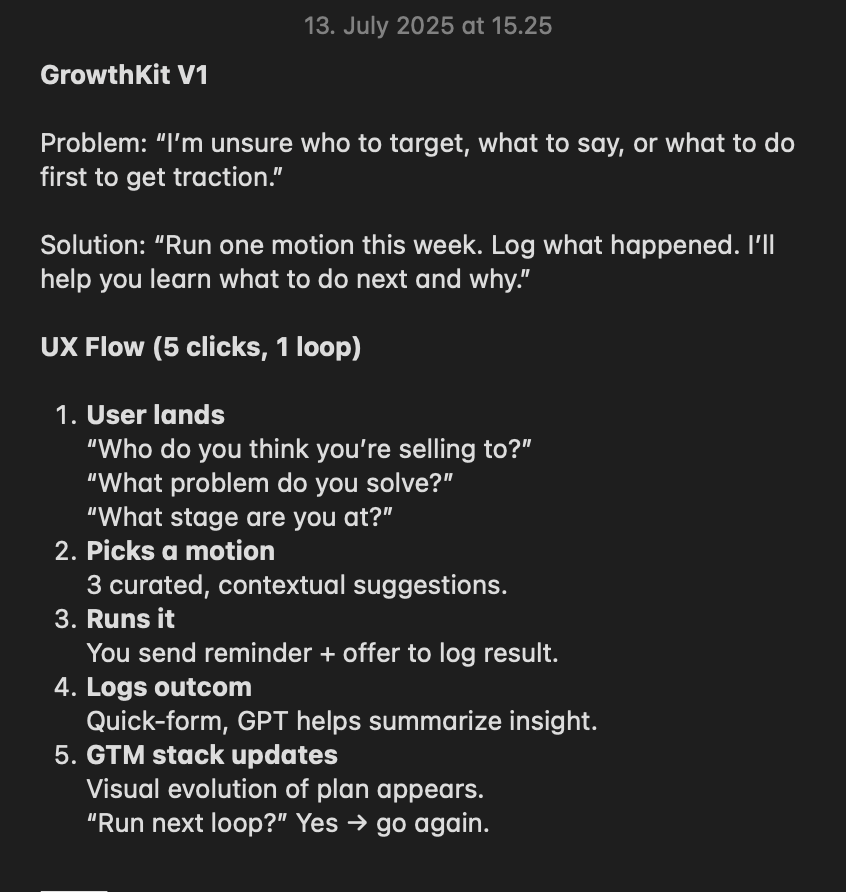
The first version is brutally simple.
- No funnel maps
- No dashboards
- No onboarding wizard
- Just one job:
Run a motion. Log what happened. Get strategic feedback.
The system will:
- Track the motion and the outcome
- Use AI to surface the insight
- Evolve the GTM stack behind the scenes
- Offer the next best motion based on what worked (or didn’t)
Why bother?
Because this model works when it’s followed.
Because most founders or growth operators have no system for learning, only for doing.
And because if you can reduce the mental load of iteration, you can increase the speed of strategic clarity.
That’s what I want to build.
A simple product that helps serious founders move faster by thinking better.
Let’s see if it works.